
Columbia Seligman Technology and Information Fund(SLMCX)
母公司 - Ameriprise(AMP)
中文名: 阿莫斯莱斯金融
2026-08-07 市值: 494亿美元,TTM PE 13.53.
J. & W. Seligman & Co. 是华尔街历史最悠久的投资银行之一,创立于 1864 年(参与过巴拿马运河融资和通用汽车的创立)。
到了 20 世纪下半叶, Seligman 专注于公募基金和对冲基金管理。
随着 2000 年互联网泡沫破裂,市场对单纯做多(Long-only)的科技基金产生了极大的风险防范需求。Seligman 于 2001 年正式推出了 Seligman Tech Spectrum 科技对冲基金(随后推出了离岸版本 Offshore Fund)。
2008 年次贷危机期间,很多中型资产管理公司面临流动性和销售渠道的挑战。2008 年 11 月,Ameriprise Financial(AMP)以约 4.40 亿美元现金整体收购了 J. & W. Seligman & Co.。
2015 年,AMP 统一旗下资管品牌为 Columbia Threadneedle Investments,Seligman 被保留为 Columbia Threadneedle 旗下的专门科技投资团队和子品牌(Seligman Investments / Seligman Technology Group)。
PAUL WICK
Paul Wick 是 Seligman Investments 的首席投资官(CIO)、资深合伙人,以及 Seligman 科技投资团队(Seligman Technology Group)的总掌门人。
他早在 1987 年(从杜克大学商学院毕业后)就加入了 J. & W. Seligman & Co.
1990 年,他正式接管了 Seligman 的旗舰科技公募基金(Columbia Seligman Communications and Information Fund)。
2001 年 6 月,为了适应市场对多空对冲的需求,他发起创立了 Seligman Tech Spectrum 对冲基金(以及后来的离岸版本 Tech Spectrum Offshore Fund)。
与其他高追高打、狂热追捧高市盈率(P/E)概念股的科技基金经理不同,Wick 坚持“以合理价格买入成长(Growth At a Reasonable Price, GARP)”。
他特别注重估值、现金流、自由现金收益率以及公司的竞争壁垒(如知识产权)。
他极其擅长深耕半导体(Semiconductors)和电子资本设备行业,往往能在周期底部挖掘出极具性价比的标的。这种注重下行风险控制的风格,使得他在熊市中回撤较小,极受机构和高净值客户青睐。
1998 年,Wick 做出决定将 Seligman 的科技投资团队从纽约华尔街整体搬迁到了加州帕洛阿尔托(Palo Alto,硅谷的核心)。他在硅谷深耕数十年,与硅谷大量的半导体巨头、软件公司高管以及供应链建立了极深的人脉和第一线研究网络。这种“驻扎一线”的独立研究体系难以被大型资管公司的普通分析师取代。
Market insights
Our internal research noted that hyperscalers hold a structural competitive advantage over neoclouds given their distribution-plus-compute model, and flagged 20% return on invested capital (ROIC) as achievable at steady state — a view increasingly supported by AWS's 39% operating margin.
The operating environment has been nearly ideal — elevated volatility drove trading revenues, a robust IPO and M&A pipeline fueled investment banking fees, and credit quality held up better than feared.
The caveat is valuation: J.P. Morgan now trades at roughly 2.7x book value and 15 –16x earnings, while Goldman Sachs is among the priciest large-cap bank on a price-to-book basis.
GLP-1 continues to be a generational growth driver, with Eli Lilly reporting 48% year-over-year revenue growth.12 Beyond GLP-1, the broader pharma group has navigated a challenging loss-of-exclusivity cycle better than expected, aided by a powerful wave of new product launches and one of the most active M&A environments in years.
The medtech group broadly underperformed, weighed down by a combination of ACA/Medicaid enrollment headwinds, broader procedure volume normalization and company-specific execution issues. The pullback has created pockets of value for patient investors.
Consumer discretionary results were mixed, reflecting a consumer that remains resilient at the high end but increasingly value-conscious in the middle.
ExxonMobil and Chevron both reported exceptionally strong results, generated substantial free cash flow and continued returning capital to shareholders. We remain constructive on the sector, particularly offshore oil services, where investment in reserve replacement and long-term production growth continues to support demand.
Cisco and Arista Networks reported robust AI-driven growth and raised guidance, underscoring the sector’s increasing dependence on hyperscaler capex. The key risk for the sector is that a meaningful portion of the current demand surge is concentrated in AI-related end markets, and any deceleration in hyperscaler capex would have an outsized impact on industrial companies with high data center revenue exposure.
Data center REITs continued to benefit directly from the AI infrastructure buildout, with leasing demand at record levels and pricing power firmly in the hands of landlords.
The critical question for investors is not whether AI is generating returns, but how long the current investment cycle can maintain its momentum. Demand remains exceptionally strong, with hyperscalers continuing to face supply constraints and reporting visibility well into 2027 and 2028. Yet the scale and concentration of AI spending mean that any moderation would likely have consequences extending far beyond Silicon Valley and the technology sector. For now, the data supports continued optimism.
Significant corporate debt issuance to fund data centers and AI infrastructure is intersecting with Treasury supply dynamics, creating new pressures and complexities across bond markets. As investors purchase newly issued corporate debt, the overall finite demand for high-quality debt investment may be constraining Treasury bond demand.
The framing has evolved from “we believe this will work” to “we know it works — we just do not know how much yet.”
Platforms that act as a source of truth appear relatively well protected because the data resides there.
Platforms with embedded data are better positioned amid an AI-driven reset for software providers. Point solutions appear more vulnerable.
They are comparing models on cost, speed and task-specific performance, and are willing to choose lower-cost alternatives where the quality gap is small.
That matters because it suggests the market may not settle around a single dominant pricing structure. Instead, value may accrue across a broader set of providers and tools, depending on the economics of the use case.
That breadth matters because AI is increasingly an infrastructure cycle as much as a technology or semiconductor story.
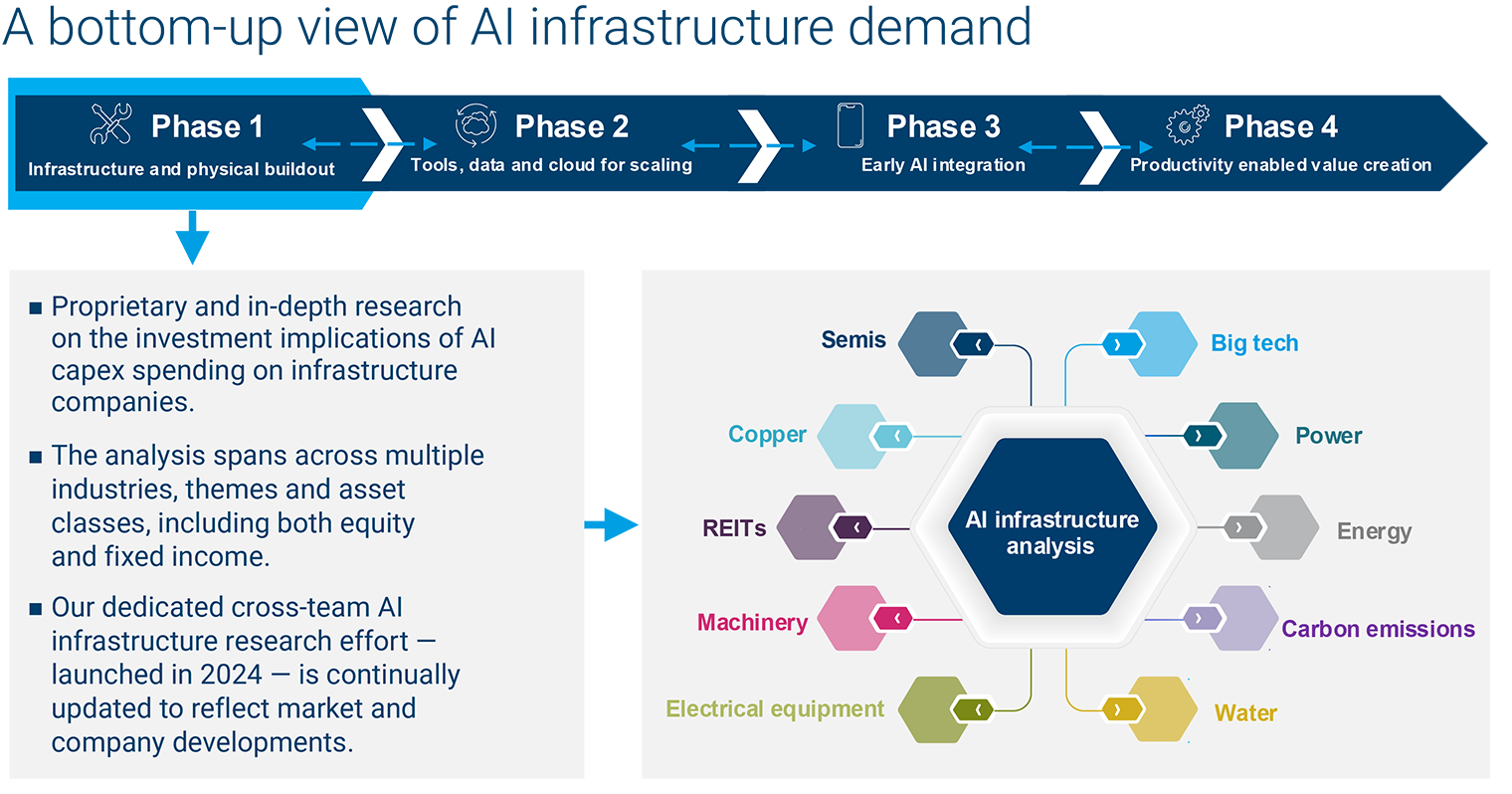
To help understand AI as an investment theme, we have developed a framework of four waves — or phases of growth.
- Today, we are concentrated on the first wave — the physical construction of AI infrastructure like data centers, which is the most capital intensive.
- The second wave is in its early stages and involves data architecture and cloud platforms as companies deploy AI at scale.
- The third wave emerges when enterprises integrate AI, as some are beginning to across their businesses.
- The fourth wave centers on value creation, as technology increasingly drives productivity gains across companies.
Our team is also considering the ‘crowding out’ effects of this investment cycle. If AI investment reaches $3.5 trillion, that figure represents nearly 3% of global GDP. It could delay other non-AI projects and have inflationary impacts across the broader economy. These dynamics are something we are beginning to analyze in detail.
报道&投资者信
PAUL WICK
In June 2001, Paul and his team launched the Seligman Tech Spectrum hedge fund, a long/short strategy investing globally in Technology, Telecom, Media, Medical and Consumer companies across all capitalization ranges.
2020-01-28 30 YEARS AT THE HELM OF COLUMBIA SELIGMAN COMMUNICATIONS AND INFORMATION FUND
When Paul Wick took over managing Columbia Seligman Communications and Information Fund in 1990, Motorola had just introduced its flip phone and Apple had recently rolled out its beige box Mac Classic personal computer. Wick has managed Columbia Seligman Communications and Information Fund for 30 years, longer than any other current portfolio manager of a U.S. technology fund.
“There are a lot of companies that are a flash in the pan in tech, and it is important to identify businesses that have staying power and won’t fizzle out,” he says. For Wick and his team, growth at a reasonable price(GARP) has always been a top priority. “We look at a lot of aspects of a company, including its products, management strength, competition, supply chain and manufacturing, but we also have an emphasis on not overpaying. Intellectual property is a really important thing — it enables long-term, sustainable, high profit margins.”
What are some of the most important lessons you have learned over your tenure as an investor in the technology sector?
Being successful in tech is not just about being first to the next big thing. It’s more important to find long-term trends with legs. The PC trend, the networking trend, the smart phone trend — these are all long-term drivers that unfold over many years. Everyone remembers an IPO like Google’s and the stories of stocks that go straight up, but the much more common pattern is for companies to flame out after their IPO. It can take a year or more to understand if a trend is going to accelerate and dominate and to understand the players in that space.
It’s important to recognize when accepted wisdom is no longer relevant. As industries mature, the dynamics change. There used to be a rule that any time the semiconductor industry saw year-over-year revenue growth above 40%, or saw unit growth in excess of 25%, the industry would go into recession within six months. These numbers made sense in the days when the PC market was driving 65% of semiconductor demand, and every chip company had its own fabrication plant and added capacity or hit the brakes at the same time. Now, with dedicated foundries dominating production, capacity adds are more granular and cyclicality has diminished. It’s unlikely that we will see the types of unit growth or revenue numbers that we had in the early days. Understanding these new dynamics is much more important than trying to apply the old rule. There are similar absolutes in other industries that have become less reliable as the world changed.
Business models matter. We have always been suspicious of high-risk business models, such as one-product companies. We focus on finding companies with strong intellectual property, a sticky customer base and pricing power. We want to see recurring revenue and free cash flow generation.
Assemble a team that balances investing skill with technical know-how. The members of the fund’s management team have all been investing in the sector for 15 years or more, but many of them also have their roots in the tech industry, working in computer software or as semiconductor engineers. They know electronics and understand the architecture of smart phones and the process development aspects of fabricating semis. This background allows them to understand which companies will benefit from a new development in semi manufacturing, for example. We believe it’s a significant advantage.
What are some of the trends that you currently like in the technology sector?
The key trend is the intersection of the cloud with software applications, mobile devices and the Internet of Things. There’s a virtuous circle at work here — faster data networks and cellular speeds enable the cloud to deliver faster search queries and streaming video speeds. Software integration advances enable new cloud services like ride-hailing services and food delivery. Cloud-based software improves security and ensures that applications are always up-to-date. And more powerful sensors and processors increase the intelligence of the cloud and edge devices like industrial machinery, home security cameras and automobiles.
Of course, there are other trends that are also exciting, such as **advances in autonomous driving and the trend toward electric cars. We are also keeping a close eye on fuel cell technology and its potential to reduce pollution and carbon emissions.
2025-12-24 This Tech Investor Likes Broadcom, Bloom Energy, and Other AI Bargains
We are fans of Wix.com, an Israeli company that is a leader in website design software. There had been concern that AI “vibe coding” would replace the need for professional software for designing websites. That fear has been blown out of proportion. Wix’s base business has continued to do pretty well, and it bought a vibe coding start-up in Israel back in June named Base44, which has been doing extremely well.
Wix stock is down about 50% this year because people fear competition from companies like Cursor, which is privately held. Cursor, an AI code editor, was just valued at $29 billion in a late-stage venture-financing round. It has annual revenue of $1 billion heading into 2026. Wix is profitable. It has a $5.5 billion market cap and generates more than $500 million a year in free cash flow. We see more positive risk/reward in the public markets than in late-stage private companies.
The narrative that Nvidia will inevitably lose share in AI processors is in the stock. But this is still a fast-growing market. Nvidia just grew revenue by 62% year over year in the latest quarter, and is guiding to 67% growth in its January quarter. It isn’t as though the company’s growth rate has slowed to a crawl or gone negative.
There are areas that feel higher-risk, including the so-called neocloud data-center companies such as Nebius Group and CoreWeave. This is something of a commodity business. It is inherently riskier because these companies don’t have significant intellectual property.
Bloom Energy has a unique story and many attributes. It makes the most-efficient fuel cells in the world. You can get these installed next to data centers within six months, as opposed to waiting years for your local utility to provide power.
Bloom got a 30% tax credit from Trump’s tax bill that no one expected. It has been able to lower the cost of its fuel cells by 10% a year for many years. Conceivably, these products will be meaningfully cheaper than gas turbines over time.
Bloom can add capacity fairly easily. It has said it can add a gigawatt of capacity for a little over $100 million. We expect Bloom to grow at a high rate possibly for the next decade.
We are skeptical of the quantum computing space. Let’s keep in mind that the four most prominent public-market quantum stocks were all created through SPACs. Quantum is an area that is perpetually five to 10 years away, and that has been the case for the past 15 years. It isn’t a replacement for AI processors. It can’t ingest huge amounts of information.
We feel that the total addressable market for quantum computing is small. It is useful for certain difficult mathematical problems and encryption. This is the reason governments are interested in quantum computing; they are nervous about people being able to break encrypted codes. But the commercial applications for quantum computing look like they are relatively trivial.
2026-06-08 IBD Wick Seligman T&I Reprint June 2026
The veteran portfolio manager of Columbia Seligman Technology and Information Fund (SLMCX) has piloted this top-performing fund for 36 years. He's seen it all: the 1990s internet boom, the rise of the smartphone, social media and now next-gen AI technology.
Since taking over Columbia Seligman Technology and Information Fund on Jan. 1, 1990, Wick delivered annualized returns of 16.7%, topping 91% of his tech fund peers, according to fund-tracker Morningstar Direct. And tech stocks are his forte.
I've noticed over the years that companies that aren't growing - and are shrinking - have a hard time being good stocks because the direction of technology is moving against them.
We prefer companies that are intellectual property (IP) rich with IP moats around them (that sell) sticky products with pricing power and customer lock-in. We also look for companies on the cusp of being very profitable and (producing positive) cash flow. And we have a strong bias towards capable people running companies, as opposed to people with a track record of failure. We like companies with higher margins and reasonable growth prospects.
IBD: Why such a big weighting (37%) in semiconductors?
Wick: One reason is scarcity value (due to) industry consolidation over the last 20 years. You have three semiconductor test companies left globally. And the top two have 90% or more of the share: Teradyne (TER) in the U.S. (which the fund owns) and Advantest of Japan. There are seven or eight meaningful analog semiconductor companies that are used for power and signal conversion. And there are needs for those chips in everything from data centers to automobiles.
IBD: The chip equipment makers benefit, too, don't they?
Wick: (Demand for) semiconductor capital equipment has remained durable. This used to be considered a cyclical industry.We always thought that the leading companies were undervalued by the market, and we've owned Lam Research (LRCX) continuously since 2009.
IBD: What's the bull thesis on top 10 holding Lam Research?
Wick: The best analogy is that chips have gone from being one-story ranch houses to skyscrapers, because they have so many layers of material in them, both logic chips as well as memory chips. The semiconductor processing demands are extraordinarily high in terms of the number of process steps. And this has been extremely beneficial for LAM and Applied Materials (AMAT), (another top 10 fund holdings as of April 30, per Morningstar.)
芯片制造三大核心工序是:光刻(Lithography)、刻蚀(Etch)、沉积(Deposition)。
当芯片建造方向由“平面扩张”转向“垂直堆叠”时,光刻(ASML)在总设备支出中的占比相对边际递减,而刻蚀与沉积(LAM 和 AMAT)的资本开支占比呈爆发式增长。
IBD: Any other chip-related stocks you like?
Wick: We own another company called Advanced Energy Industries (AEIS) that we've had for the last 12 years in our funds. It is a supplier to both Applied Materials and Lam Research. So, it's benefiting from those same trends.
IBD: Talk about top holding Bloom Energy (BE), dubbed "the fuel cell king."
Wick: It's the only fuel cell company that's ever been successful. Bloom Energy came out of NASA. It was originally going to be the power source for a probe that was going to Mars about 25 years ago. We've owned Bloom since 2019. The company went public in 2018, and the stock sank like a rock. There were a lot of doubters.
IBD: What did you see in Bloom that others didn't?
Wick: One of my colleagues became convinced that their technology was going to be extremely successful over time, and the company would be able to continuously reduce costs and unlock a much bigger potential market. And that's exactly what has happened. We felt Bloom would become a big company, and the market disagreed with us. The stock went nowhere for a long time. We just kept buying more and more of it and we got up to an ownership position of 19.9% as of June of 2025.
Since then, the stock has just exploded. They've emerged as the best power source. (The industry is) able to put up data centers quickly because they can add capacity easily at a high return on capital, So, this is in a way the perfect Warren Buffett stock. Buffett always looked for companies that could make more investments and get high returns on capital from those investments. Bloom is at a point where there is so much demand for power for data centers that Bloom by itself, even if they're growing their capacity 150% a year, won't be able to satisfy it.
It's all pointing to an extremely bright future for Bloom. The stock has gone up tremendously. It is still our biggest position, but just from a risk-control standpoint, we have pared our position back, but it's over 10% of assets in the fund.
IBD: How does the fund manage risk?
Wick: Historically, technology funds have gotten in trouble when they drove over the cliff and became indifferent to risk. My sense is a lot of our competitors really drink the Kool-Aid. Exceptionally high valuations in combination with a market downturn is a recipe for problems.
IBD: How does your strategy differ?
Wick: We are valuation aware. We take risk into consideration. Recently, we've been taking a certain amount of gains in some of our big winners and looking for alternative investments, such as companies that have good fundamentals, but whose stock prices have lagged. In many cases, those companies are lower beta than the broad market.
IBD: What laggards have you been buying?
Wick: Companies like (online dating app) Match Group (MTCH), (ride-hailing service) Lyft (LYFT) and (web hosting company) GoDaddy (GDDY). These are good businesses with very low valuations. They've been left behind in the AI stampede. But it's not at all clear to us that these companies are AI losers. We really don't think so. We've recycled some of our gains into these lower risk, low valuation, less volatile stories.
IBD: Are these big IPOs sending a market signal, a top perhaps?
Wick: I don't buy the analogy to 2000, because it's very different. There was something like 500 IPOs in 1999 and the first half of 2000. We don't have anything close to that.
IBD: What lower-valuation stocks do you like? Wick: Lyft is a good example. There's been this narrative that rideshare is going to be either a winner-takes-all category or autonomous vehicles are going to render it an irrelevant category. Given all the problems that Tesla (TSLA) is having with its robotaxis, essentially no progress since they rolled it out a year ago in Austin, Texas, I think the threat from autonomous vehicles is overstated. It's going to be a slow, methodical transition. I don't think it's a winner-takes-all business.
IBD: Any turnaround plays you're adding to?
Wick: (Cloud security and data center traffic management company) F5 Networks (FFIV). F5 had gone through a slow growth (phase). They've seen a resurgence in their growth rate in the hardware part of their business from 1% or 2% to more like 10% now. The stock had become very cheap. So, we bet on a turnaround there four or five years ago. But we sold our entire position last fall between 300 and 320.
IBD: Did you get back in?
Wick: The stock sold off hard last fall after they were hacked. It went down below $250, and we bought it back. Our analysis suggested that it wasn't going to be significantly impacted by the hack. And their business has come back very strongly. After the hack, they were extremely conservative and lowered earnings guidance. They've since revised the forecast up. The stock has gone from 240 (a share) to 383 as of May 29.
IBD: What's your message to investors as tech stocks go parabolic?
Wick: It's important to ask yourself how much of the good news is baked into share prices. And ask yourself: Are there other companies that are doing particularly well, and no one is paying attention?
2026-06-30 SELIGMAN 广泛科技离岸基金 – CLASS A
对于 Tech Spectrum 而言,当前环境犹如淘金成功,因为我们的多头投资组合充满了 AI“卖铲人”(Picks and Shovels)企业—包括半导体计算与连接、网络系统、AI 电力相关企业、存储组件与系统、计算机以及半导体资本设备公司。另一方面,我们在软件、互联网及支付类股票上的投资已连续第二年整体表现不佳。幸运的是,我们围绕 AI 相关受益股票的布局所带来的良好表现,已充分弥补基金其他领域表现令人沮丧的影响。
简要回顾一下今年的表现领先者:
- AI 电力:Bloom Energy 和 Forgent Power Systems;
- 数据网络:Arista Networks、Coherent、Cisco 和 F-5 Networks;
- 存储、计算与数据存储:Micron Technology、Sandisk、NetApp、Hewlett Packard Enterprise 和 Western Digital;
- 半导体设备:Lam Research、Applied Materials、Teradyne、Advanced Energy Systems 和 Rigaku;以及
- 半导体:Broadcom、Marvell、Semtech、Taiwan Semiconductor、ON Semiconductor、NXP Semiconductor、Synaptics、Lattice Semiconductor、Renesas Electronics 和Qualcomm。
这些股票推动了基金今年的表现。是的,我们仍然持有 Nvidia。受强劲增长和盈利能力推动,其今年表现为正,但与上述公司并不在同一层级。由于其市值已超过 4 万亿美元,行业中的许多共同基金和对冲基金已将 NVDA 作为流动性来源,因为基金经理普遍不愿将其配置权重提高至 10%以上。
资本回报率是否足以证明如此庞大的支出是合理的?没有人知道答案,但我们对于 AI 支出的投资资本回报率(ROIC)已忧虑了一段时间。这使得我们在过去一年中对 Meta 和 Amazon 的看法转趋谨慎偏空,同时也让我们对 Oracle 和 Microsoft 的持仓保持更加审慎的态度。然而,我们仍然维持 Google 的较大仓位,因为其已经明显成为 AI 领域领导者,拥有表现优异的前沿大语言模型、在付费搜索领域持续保持主导地位,以及增长最快的云计算业务。
未来是否会有足够多的企业和个人使用并付费购买 AI 应用及 AI 代理,从而形成持续性的收入来源,最终覆盖这些巨大的资本投入?截至目前,答案仍然是“不能”。但风险投资机构及超大规模云服务商通过补贴成本,使这一飞轮得以持续运转。如果 Anthropic 和 OpenAI 能够效仿 Space X,通过 IPO 获得更多巨额融资,那么 AI 行业将获得更长的发展窗口期,从而有更多时间证明其巨额投入最终能够转化为可接受且可持续的投资回报。
每天,我们都会紧张地浏览新闻,试图寻找线索,以判断这一切最终将如何发展,但这极其困难。然而,我们的感觉是,目前距离周期顶部已经比距离底部更近。因此,我们一直在逐步减持表现强劲的 AI 赢家,并将资金重新配置至科技行业中其他我们认为被市场忽视,或被错误归类为“AI输家(AI Losers)”的领域。近几个月来,我们已完全卖出 Renesas Electronics(TSE: 6723,RNECY) 和 Rambus(RMBS),并对大部分排行榜中的持仓实现部分获利了结,尤其包括 Bloom Energy(BE)、Semtech(SMTC)、Marvell(MRVL)、ON Semiconductor(ON)、Lam Research(LRCX)、Teradyne(TER) 以及 Applied Materials(AMAT)。我们还参与了近期几宗大型科技 IPO—Space X、Quantinuum 和 Cerebras,并在三家公司上均获得了可观收益后全部卖出。这也让我对于我们与 Morgan Stanley 长期以来的合作关系深感感激,因为该行正是上述三宗交易的承销商。
迄今为止,我们从 AI 领域进行分散配置的努力整体而言令人失望。我们增持了 Match Group、Go Daddy、Gen Digital、Pinterest、Lyft、Docusign、Bill Holdings、Global Payments、Tenable Software 及 Palo Alto Networks;其中仅有网络安全相关公司(Palo Alto、Gen Digital 及 Tenable)的股价上涨,其余公司股价则继续下跌或维持横盘走势。
我们还在其他一些软 件 公 司 中 建 立 了 小 规模 新仓 位— Commvault、Hubspot 和 ServiceNow—但只有Commvault 实现了股价上涨。
投资者继续回避软件股,因为他们认为基于“席位(Seat-based)”收费的软件模式将受到“无席位(Seatless)”AI 代理的冲击。我们认为市场对于软件行业的悲观情绪被夸大了;最终,该行业的并购活动将会恢复,股票回购将缓和抛售压力,而投资者也将重新建立信心,相信 AI 会改变软件行业,而非消灭软件行业。在大多数情况下,我们正在耐心等待,因为当前的负面叙事与相对良好的基本面表现以及许多衡量标准下极度低迷且便宜的估值水平并不相符。例如,Pinterest 在 3 月份季度交出了极其优异的业绩,实现 18%的收入增长,同时利润和现金流增长表现更佳;公司还回购了其已发行股份的 16%。奇怪的是,尽管 AI 风险极低,且当前年度自由现金流估值仅为 8 倍,该股股价却一直横盘整理。
今年迄今为止,我们最大的烦恼是以色列网站软件开发商 Wix。虽然 Anthropic Claude 和 Lovable 等 AI 工具能够创建一些简单网站,但 Wix 拥有其自主开发的 AI 编码解决方案 Wix Harmony,与市场上其他同类工具相比,它在 Vibe Coding 方面不仅效果更好,成本也更低。 此外,Wix 还拥有一家从事 Vibe Coding 业务的子公司 Base 44,其收入每年增长超过 100%, 但由于需要向 Anthropic 支付推理(Inferencing)Token 成本,因此仍严重亏损。2026 年, Wix 核心业务预计将产生约 7 亿美元自由现金流,但 Base 44 预计将在约 2 亿美元收入基础上消耗接近 3 亿美元现金。Wix 目前正开发自有内部语言模型,这将显著降低 AI 推理成本,并最终使 Base 44 实现盈利。然而,这一转变预计要到 2027 年才能实现,而在此之前投资者基本已经放弃了 Wix。公司拥有 11 亿美元零息可转换债券,股权市值为 17 亿美元,而今年预计收入可达 20亿美元,自由现金流约为 4.25 亿美元,明年自由现金流则可能达到 5 亿至 6 亿美元。我们希望随着 20%的员工缩减以及使用自有 LLM带来的推理成本改善,Wix 的盈利能力将在 2027 年和 2028年迎来明显拐点。
2026-07 天利科技基金市场观点7月
我们积极减持了 AI 供应链中的部分获利仓位,包括 Lam Research、Western Digital、 Marvell 及 Bloom Energy。由于这些持仓已达到内部目标价位且仓位规模明显扩大,因 此我们出于估值及风险管理考虑进行了调整,而并非投资逻辑发生改变。目前我们保留部分现金仓位,等待早期财报提供更清晰的市场信号后再重新部署。
部分资金已重新配置至 TSMC(台积电),我们认为当前前估值极具吸引力。
我们也增持了部分精选软件公司,包括 Wix(WIX)、 Trimble(TRMB)、 DocuSign(DOCU)、 HubSpot(HUBS) 及 ServiceNow(NOW)。我们仍将逐步增加软件板块的配置。
最 高 信 念 多 头 持 仓 : Lam Research(LRCX)、 Applied Materials(AMAT) 、 Nvidia(NVDA) 、 Broadcom(AVGO) 及 Bloom Energy(BE)。
半导体设备领域台Lam Research、Applied Materials,:覆盖存储器与逻辑芯片市场,具备多年增长能见度,并受惠于 Intel、 TSMC、 Samsung、 Micron 及 SK Hynix 持续增加资本开支。无论未来最终由 GPU、 ASIC 还是存储器受益于 AI 浪潮,该领域均能从中受惠。
AI 算力领域台Nvidia、 Broadcom,: Nvidia 受惠于 Rubin 产品周期; Broadcom 则受惠于 ASIC 需求增长、网络设备需求提升以及当专有 IP 优势。
空头组合主要主题:可选消费类股票台如 Wayfair(W) 和 Carvana(CVNA),、航天相关企业、小型核能公司,以及部分生物科技与医疗科技企业。
Bloom Energy
尽管近期股价波动较大, Bloom 仍然是我们最具信心的持仓之一。我们的判断建立在广泛的供应链调研基础上,数据显示市场需求持续大幅超出市场预期。我们认为 AI 驱动的数据中心电力需求将成为重要增长动力,而 Bloom 是少数能够在 6 至 9 个月内完成部署且具备规模化能力的电力解决方案供应商之一。
对于市场担忧的融资问题、订单积压质量以及钪台Scandium,供应等因素,我们并不过度担心。Oracle 项目的持续推进、供应商扩产进展以及 Bloom 管理层确认拥有足够钪供应支持未来增长,均进一步强化了我们的投资逻辑。
Alphabet
Alphabet 目前是我们在“美股科技七巨头台Magnificent 7,”中的首选标的。我们认为市场对当最新业绩的负面反应,主要源于投资者担忧 AI 资本开支上升对短期自由现金流带来的压力,而非核心业务出现恶化。在我们看来,这些投入对于支持长期增长至关重要。与此时,,我们继续看到 Google Cloud、 Search 以及 Gemini 等业务保持积极发展势头。
虽然 Gemini 目前未必在所有领域都处于领先地位,但我们认为 Google 拥有多元化的 AI 变现路径,包括 GCP 云平台、 TPU 芯片、企业级 AI 部署以及面向消费者的 AI 产品。此外,Google 仍拥有庞大且持续增长的云业务订单储备。结合我们认为在“科技七巨头”中最具吸引力的估值水平,Alphabet 依然是大型科技股中风险回报比最具吸引力的投资机会之一。
2026-09-17 2026 Q2 Tech Offshore Investor Letter
Intuit had a weak quarter in Turbo Tax, but Quick Books and Credit Karma were healthy. Overall, the market chose to penalize the company for slightly slower overall growth, but the company’s expense reductions and share repurchase have juiced earnings per share growth, which has prompted us to add a bit on weakness.
Fiverr had a disappointing outlook, as AI has impacted their freelancer business for creative tasks; however, the company is still profitable and trades at almost no premium to cash on the balance sheet, leaving us inclined to hang on and wait for their higher value project business to take up the slack.
EPAM slightly lowered its expectations for revenue growth, but higher margins and share repurchases left earnings per share unchanged. Given a shockingly low valuation, we elected to stick with EPAM and slightly add to it, a good decision, given the stock recovery in August.
We were underwhelmed by Trip Advisor’s results and are thankful it’s not a significant position; TRIP was able to sell its European dining reservations business, The Fork, for a great price in Q2, but the company’s Viator division and core Trip Advisor both had anemic quarters. Pro forma for the sale of The Fork, TRIP is now trading at 4X free cash flow.
Memory chip pricing remains elevated, driven higher by the compute needs of AI data centers, particularly so-called High Bandwidth Memory and KV Cache Flash applications.
At the moment, rising supply seems like the more plausible scenario, which is highly beneficial to Lam Research, Applied Materials, Teradyne, and Advanced Energy. Lam posted blow out earnings and guidance, with revenue forecast to grow 50%+ over the next four quarters. The strong demand for Memory and advanced logic for GPUs, XPUs, CPUs, and Network ICs is incredibly positive for the group. Usually, Taiwan Semiconductor has construction or upgrade activity underway at 8-10 facilities at any given time; today, they have 13 projects in Taiwan alone, plus another 12 projects in the USA, Germany, Japan, and elsewhere. The world’s leading memory chip companies are also feverishly trying to raise production, but new plants take a long time to build. As a result, Micron, Sandisk, SK Hynix and Samsung have all warned that supply will likely be even tighter over the coming year.
We had sold half of our AMAT position and 20% of our Lam Research in June given the spike in their stock prices; with share prices having retreated considerably in the last two months at the same time estimates have surged higher, we are feeling confident again on the risk / reward in Semi Cap (Semiconductor Capital Equipment) shares.
We have recently been adding to Rigaku, a Japanese X-Ray inspection technology company that is well positioned for the growing need to use X-Rays in defect detection on leading edge chips.
We were thrilled to see a takeover offer for Synaptics in late June from ON Semiconductor. Unfortunately, the all-stock bid proved to be vulnerable to the chip stock sell off that ensued immediately afterwards. In hindsight, ON Semi shares were somewhat overheated in June, but the stock has subsequently dropped from a high of $135 to the low $70s, now valuing ON at only 15X 2027 estimated earnings at a time when its earnings and margins are cyclically improving. We see the SYNA acquisition as accretive and strategically important for ON and view the sell-off in both stocks as a buying opportunity. The SYNA transaction is expected to close in the first half of 2027.
Bloom Energy grew revenues 165% in their June quarter, dramatically exceeding consensus estimates. We continue to think the stars are aligned for Bloom – fastest time to power, highest efficiency source of electricity, no noise or particulate emissions, no water usage. All these attributes make Bloom an attractive alternative for data center developers facing opposition from community activists worried about noise, pollution, and the environment. As a result, we think Bloom can continue to grow at a strong pace into 2028, significantly boosting their margins and earnings at the same time.
In late June Bloom moved from the Russell 2000 to the Russell 1000 and the lower ETF driven demand combined with a risk off sentiment around semis in July put downward pressure on the stock. In addition, rumors of a forced hedge fund seller in the market exacerbated a weakness in the shares. In early September, it was announced the stock would be added to the S&P 500 which provided an uptick in trading volume and helped the stock recover some price gain. It’s been a crazy ride, but we have been correct in staying involved as a large holder while prudently managing the size of our position. Bloom remains our largest holding at roughly 11% of capital.
In our last letter, I had mentioned that we had cut back other Semiconductor device holdings, including halving our positions in Semtech and Marvell. Both companies’ shares fell hard during the July / August correction, but both have delivered exceptional results in the interim. Semtech’s revenue growth has reaccelerated to 50% driven by optical chip demand at data centers; we added back to the position and see a continued upside potential in Semtech.
&&We sold the last of our F-5 Networks position in July**, as it had reached our target. F-5 had been a sleeper AI beneficiary and security stock that we had owned for most of the past six years, with roughly a triple return over that holding period. Very few brokerage firms recommended the stock over that period, cementing my belief that brokerage firm research may not be the only reputable source to rely upon.
We’ve held a large position in NetApp for most of the past 20 years as well, and the firm has had tepid brokerage firm sponsorship. Nevertheless, the company has prospered, with operating margins rising from 20% to 31% and share price rising from $60 in 2023 to $185 today.
I’m pleased to report that three of our “value tech” holdings in Internet have finally sprung to life recently – namely, Match Group, Go Daddy, and Wix.
New CEO Spencer Rascoff has streamlined Match Group at the same time that the company has offered new dating products like “Double Date” while using AI technology to improve dating outcomes and remove bad actors. MTCH had been reliably reducing its share count roughly 7-8% per year as it sought to improve a wilting Tinder business; the new offerings have finally turned around the ship, and MTCH shares have begun to outperform after three years of going sideways. We’ve been patient here and early signs are showing that the patience appears to be paying off.
With Go Daddy, relentless fears of AI or search engine disintermediation had hammered the stock over the last two years, along with the loss of the “.CO” (country of Columbia) internet domain. Go Daddy is a mature business with a strong, stable base of recurring SMB customers that has become more profitable over time. We’ve been gradually adding to our position over the last year on weakness, biding our time as the company repurchased 7% of shares outstanding year after year. Our sense is that comparisons improve in 2027, as the company anniversaries the loss of the Columbia domain, boosting core revenue growth.
With Wix, the key new development was that the company created its own Large Language Model for Base 44 inferencing, raising their vibe-coding gross margins from 0% to 60% overnight, starting in July. The company delivered a reassuringly good June quarter when they reported in August, and we are hopeful that profitability has a long way to go higher. While the shares have risen off the bottom, we see significant upside to the current $77 stock price given 2027 free cash flow of $12-13 per share.
Many of our other non-AI stocks performed well in the past ninety days, including Atlassian, ServiceNow, Salesforce, Ring Central, Tenable, Gen Digital, Block, Visa, Global Payments, AirBnB, Unity Software, Docusign, and Palo Alto Networks. Many of these stocks were left for dead by other investors who thought that AI was going to eviscerate their businesses.
ServiceNow is fairly new for Tech Spectrum and we’ve kept adding, while we have also added to Docusign, which is still selling for only 10X free cash flow.
Ring Central has had an enormous move off the bottom, and we have sold over half of our position; we’ve also cut back in Atlassian, Unity, AirBnB, and Palo Alto Networks.
We remain extremely bullish on LYFT; fundamentals continue to improve under CEO David Risher while the valuation is quite modest. Margins have been expanding for the last three years, and the company has grown booking by high teens; free cash flow is routinely over $1Bn per year and the company has bought back 4% of shares outstanding in the past year. Nevertheless, LYFT’s valuation remains stuck at only $5Bn for the #2 player in a natural duopoly with high barriers to entry. Seligman is now the company’s largest shareholder, and we see significant upside in LYFT shares. The threat from autonomous vehicles seems overblown, as Tesla’s entry has been almost unmeasurable and Waymo hasn’t scaled to meaningful size.
UBER is also undervalued as a result of these unfounded autonomous vehicle fears, and we have recently initiated a long position in UBER shares as well.
We see a similar set up to LYFT in Pinterest, which has a loyal and growing clientele of users of its web platform. We’ve owned the stock for the last three years, and it’s been a disappointment. We sold some of our shares for a solid gain in 2024 above $40, but the stock has since fallen to between $14 and $20, even though earnings per share have risen from $1.09 in 2023 to an estimated $2.04 this year. PINS sells for less than 7X estimated free cash flow in 2027 and bought back 16% of shares outstanding earlier this year. The stock has recently weakened because of a CFO change and the company’s growth rate falling from 18% in 1H 2026 to 15% in 2h 2026, and we are very comfortable buying the weakness.
We remain short IONQ, D- Wave Quantum, Rigetti, and Quantum Computing. Two of these companies have used their cash and stock to buy mediocre chip companies to make it appear that there’s “more there” than there really is. IONQ is buying Skywater, a lagging edge chip foundry that few have focused on; IONQ has labeled them as the premier “quantum foundry” chip company, even though their quantum revenue is only a few million dollars per year. Similarly, Quantum Computing is buying the chip division of LIDAR company Luminar, a company that filed for Chapter 11 bankruptcy in December 2025.
In our opinion, Rocketlab is a viable company that doesn’t make money and has too high of a value; AST Space will either go broke trying to get its satellite constellation in orbit or will go broke when they turn on the service and it can’t make money. We feel it’s Iridium part two.
Our largest shorts are in Tesla and Corcept Therapeutics. Not much has changed at Corcept since our last letter, but Tesla’s car sales have continued to sputter. Meanwhile, the new Cybercab does not seem to be advancing their autonomous vehicle rides business, being relegated to just Austin, TX and having already drawn a challenge by Federal regulators. US unit sales were down 20%, 21%, and 26% year over year on a unit basis in June, July, and August. Meanwhile, the company has settled multiple lawsuits over fatal accidents related to FSD and unsafe door handles, with no disclosure on the size of the payouts. In recent weeks, there have been new safety incidents of Tesla cars under FSD getting into fatal accidents. I can’t imagine that the Robotaxi business has much of a chance of being successful given the problems with the “vision only” approach.
In 2022, Tesla had industry leading operating margins of 17%, earnings per share of $4.07, and a stock price that ranged from $325 and $130; today, the stock price is $354, while operating profit margins are 1%, earnings per share are forecast at $1.66, and revenues are growing modestly. The model lineup hasn’t appreciably changed in four years, and there’s nothing new on the horizon.
产品
Columbia Seligman Technology and Information Fund
MorningStar: Columbia Seligman Technology and Information Fund Class A(SLMCX)
seligman-tech-and-info-brochure.pdf
This fund takes a distinct approach to investing, combining rigorous valuation methods with a focus on long-term opportunities for growth.
Our team of portfolio managers, led by technology expert Paul Wick, takes a growth-at-a-reasonable-price (GARP) approach — aiming for a smoother investment to deliver higher returns experience with competitive returns and lower risk.
Seligman Tech Spectrum (Offshore) Fund
November 30, 2025 Seligman Tech Spectrum Offshore Fund
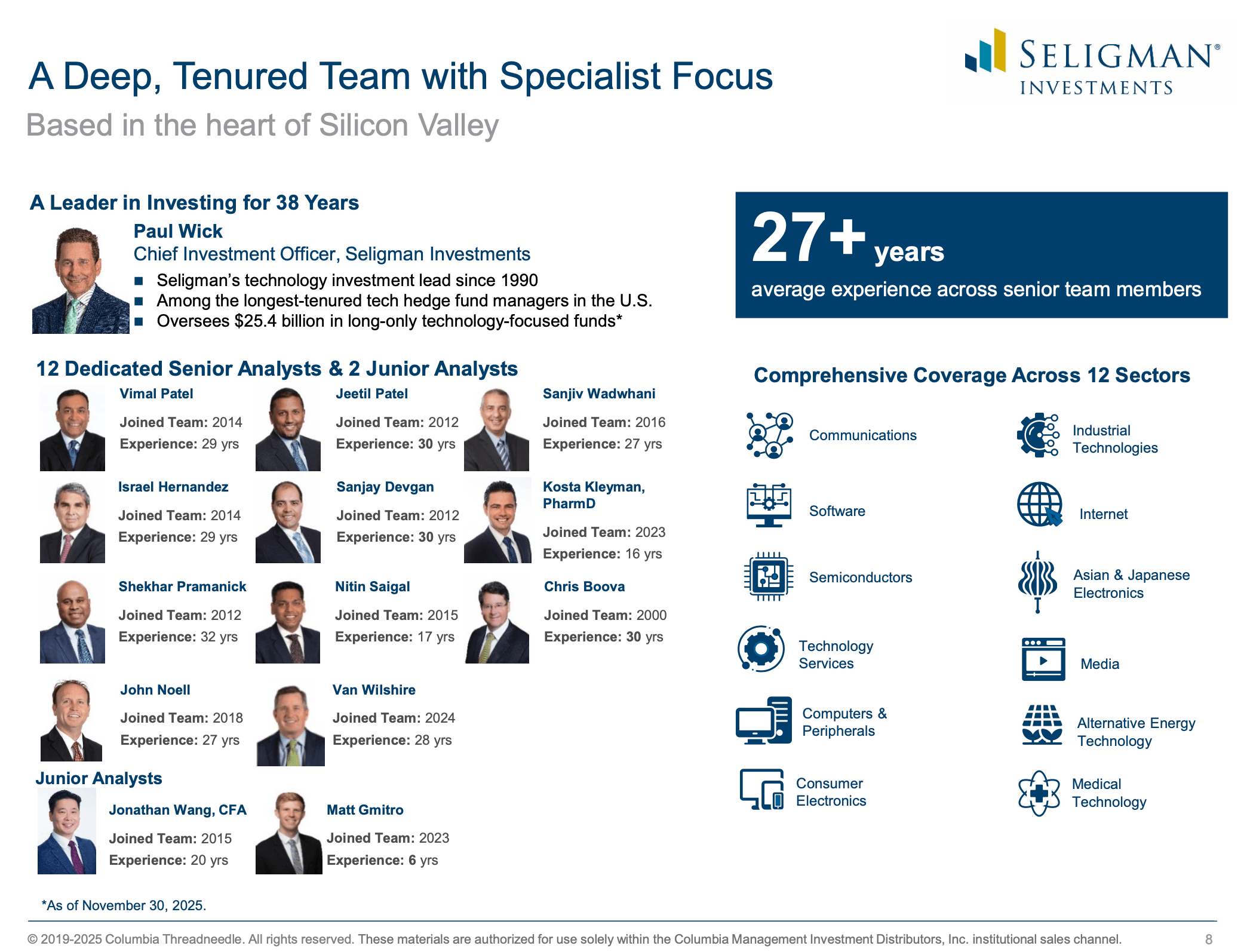
Shekhar Pramanick
Key Responsibilities: Semiconductor, semiconductor equipment and Asian electronics industries
Relevant Prior Experience:
- Specialized electronics research at Elemental Capital
- Semiconductor analyst at Seasons Capital Management, a long-short technology fund
- Lead technology development engineer at Advanced Micro Devices, generating more than 50 patents
Education:
- PhD in Materials Science and Engineering from North Carolina State University
- MS in Physics from University of Oregon
- BS in Electrical Engineering from National Institute of Technology, India
Sanjay Devgan
Key Responsibilities: Semiconductor investments, including communication ICs, analog ICs, CPUs, and PLDs
Relevant Prior Experience:
- 2004 – 2012: equity research on the semiconductor industry at Morgan Stanley
- 1994 – 2004: key positions within the tech industry and Advanced Micro Devices and Cisco Systems
Education:
- BS in Psychobiology from University of California, Los Angeles
- MBA in Finance and Information Systems from Santa Clara University
Jeetil Patel
Key Responsibilities: Entertainment software, internet, media
Relevant Prior Experience:
- Senior internet analyst at Deutsche Bank Securities
- Technology sector analyst at Hambrecht & Quist
Education:
- BA in Economics from University of California, Los Angeles
【运作报告】天利Seligman广泛科技离岸基金2026年5月报(英文版)
| Year | Seligman Tech Spectrum Offshore Class C (Net) | NASDAQ | S&P 500 |
|---|---|---|---|
| 2021 | 49.21% | 22.18% | 28.71% |
| 2022 | 1.22% | -32.54% | -18.11 |
| 2023 | 11.07% | 44.64% | 26.29% |
| 2024 | 14.36% | 29.57% | 25.02% |
| 2025 | 18.09% | 21.14% | 17.88% |
Columbia Seligman Premium Technology Growth Fund(STK)
- Total Annual Expense: 1.12%
- IPO date: 11/24/2009
- Commencement of operations: 11/30/2009
2010 - 2013/2014业绩一般。
最近一年涨幅好高,80%。
MorningStar: Columbia Seligman Premium Technology Growth Fund(STK)
Tri-Continental Corporation(TY)
- Total Annual Expense:0.61%
- IPO date: 1/5/1929
- Commencement of operations: 1/14/1929
MorningStar: Tri-Continental Corporation(TY)
全资本结构配置:
TY 并不局限于只买股票,它的资金可以灵活分布在一家公司的各个资本层级中。
其投资组合通常是一个“混合体”,包含 65% - 75% 的大型蓝筹普通股(如英伟达、苹果、微软等),其余部分则配置于可转换债券、优先股、企业债券以及高级贷款。
量化与基本面结合的双重驱动:
在选股上,基金经理采用了一套非常纪律化的量化模型。该模型主要从三个维度对标的进行评估打分:
- 质量 (Quality):公司的财务健康度和盈利能力。
- 估值 (Valuation):股票当前价格是否被低估。
- 催化剂/动量 (Catalysts/Momentum):是否有推动股价上涨的近期因素。
收益全额分配政策 (Earned Distribution Policy):
基金的政策是将底层资产产生的所有收益(包括股息、利息以及实现的资本利得),在扣除管理费用和优先股股息后,尽可能全额分配给普通股股东。
这使得该基金创下了连续 75 年以上派发股息的惊人纪录。
作为一只采用杠杆的混合型封闭式基金,TY 面临一些区别于普通共同基金的特定风险:
折溢价风险(Discount to NAV):
封闭式基金的份额是固定的,在交易所买卖的价格由市场供需决定,因此其市场价格经常偏离其真实的资产净值(NAV)。
TY 在历史上绝大多数时间都处于折价交易状态(例如折价 10% 左右)。如果你在折价收窄时卖出能获利,但在折价扩大时会遭受额外损失。
杠杆放大风险:
该基金通过发行优先股等方式使用了杠杆。
在牛市中,杠杆能有效放大收益和票息;但在市场剧烈调整时,杠杆会不成比例地放大净值的回撤和本金损失风险。
量化模型失效风险:
基金的选股高度依赖其内部开发的量化因子模型。如果宏观环境发生范式转变(例如极端黑天鹅事件),历史数据驱动的模型可能会暂时失效,导致其表现跑输大盘。
利率与信用风险:
由于投资组合中包含了约 25% - 35% 的固定收益资产和可转债,当宏观利率快速上升时,这部分资产的价格会下跌。
此外,部分资金投资于非投资级别债券(垃圾债),在经济衰退期面临较高的违约风险。
派息历史
Tri-Continental Distribution Policy and History
Tri-Continental Corporation Annual Report
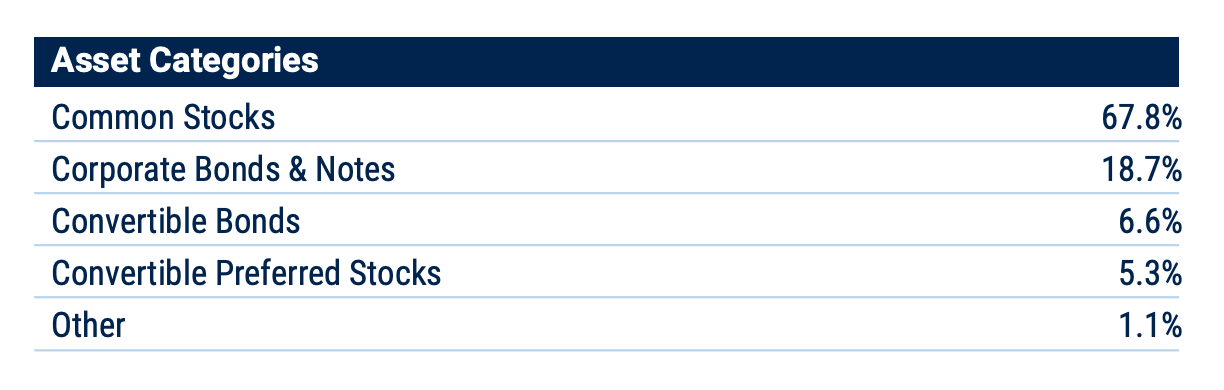
As of December 31, 2025, the only senior securities of the Fund outstanding were 752,740 shares of its preferred stock, $50 par value. The dividend rate as of December 31, 2025 on the preferred stock was $2.50 per annum payable quarterly. Based on the net asset value of the Fund’s common stock on December 31, 2025, the Fund’s portfolio requires an annual return of 0.10% in order to cover dividend payments on the preferred stock.

Tri-Continental Corporation 2026 First Quarter Report
TY股债策略的历史回撤高于ADX的纯股策略
TY 目前由哥伦比亚天利(Columbia Threadneedle)管理,但在 2008 年底之前,它的管理人是老牌投行 J. & W. Seligman。
在这家机构管理的末期(恰逢2008年次贷危机),TY 极其激进地重仓了大量金融类股和金融衍生类债券。
当金融海啸席卷而来时,TY 遭遇了史诗级的精准“爆破”,NAV 出现了灾难性的缩水。直到后来更换了管理公司,其净值走势才相对平稳下来。
2009年之后,TY的表现和ADX差不多了。